

Smart Ticketing Market Trends Shaping Contactless Travel Payments and Digital Mobility by 2032
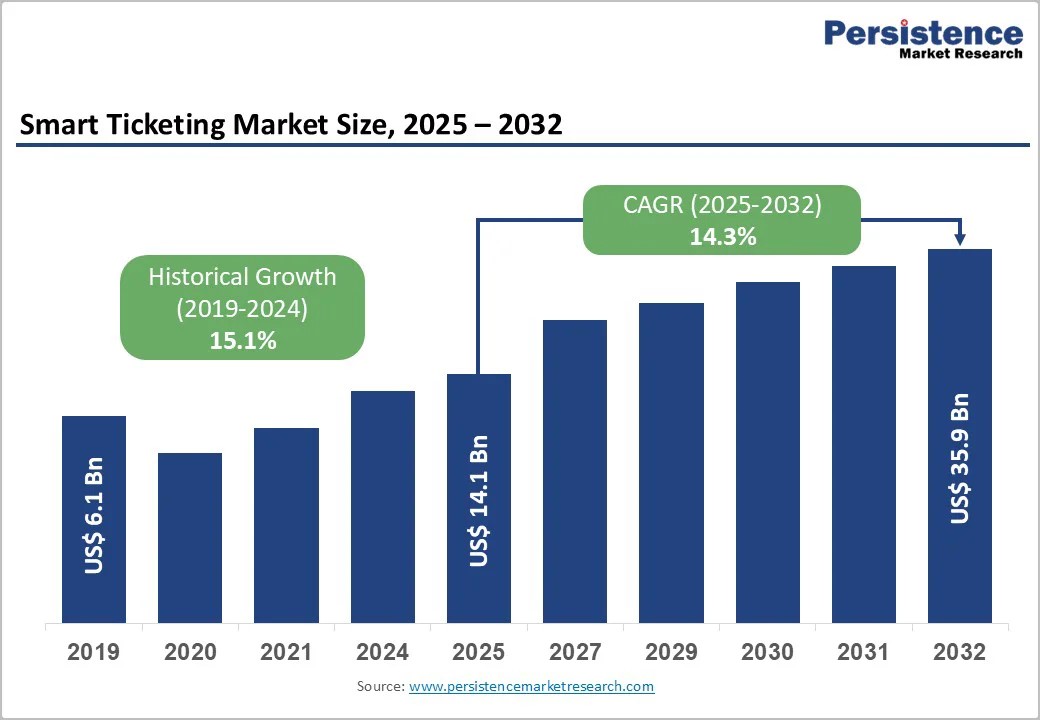
The global smart ticketing market is worth US$14.1 Bn in 2025 and is forecast to reach US$35.9 Bn by 2032, growing at a 14.3% CAGR during forecast period
BRENTFORD, ENGLAND, UNITED KINGDOM, February 6, 2026 /EINPresswire.com/ -- The smart ticketing market is undergoing a fundamental transformation as transportation systems, event venues, and public infrastructure rapidly shift toward digital-first access models. Smart ticketing replaces traditional paper-based tickets with electronic, mobile, or contactless solutions that improve efficiency, reduce fraud, and enhance the user experience. These systems are now integral to public transit, parking, tolling, sports venues, and entertainment hubs worldwide.
In 2025, the global smart ticketing market is valued at US$ 14.1 billion and is projected to reach US$ 35.9 billion by 2032, expanding at a strong CAGR of 14.3%. Market growth is powered by accelerating urbanization, post-pandemic demand for contactless payments, and sustained government investments in smart city ecosystems. Europe leads the market with a 32% share, supported by mature digital infrastructure and regulatory alignment, while e-ticketing dominates as the leading segment due to its scalability, sustainability benefits, and seamless mobile wallet integration.
𝐆𝐞𝐭 𝐚 𝐒𝐚𝐦𝐩𝐥𝐞 𝐏𝐃𝐅 𝐁𝐫𝐨𝐜𝐡𝐮𝐫𝐞 𝐨𝐟 𝐭𝐡𝐞 𝐑𝐞𝐩𝐨𝐫𝐭: https://www.persistencemarketresearch.com/samples/19954
Smart Ticketing Market Statistics and Performance Snapshot
The smart ticketing industry has demonstrated consistent momentum, supported by favorable historical performance and strong forward-looking indicators. Between 2019 and 2024, the market recorded a robust 15.1% growth rate, reflecting early adoption of mobile ticketing and QR-based access systems across transit and entertainment venues. This historical expansion laid the foundation for today’s NFC- and cloud-enabled platforms.
Looking ahead, growth is being shaped by technology convergence and ecosystem partnerships. NFC-based ticketing is projected to be the fastest-growing technology, with transaction volumes expected to surge from 11.2 billion in 2025 to 44.8 billion by 2030. Asia-Pacific is emerging as the fastest-growing region at 16.9% CAGR, led by China and India, where large-scale transit expansions and digital payment mandates are accelerating adoption across urban populations.
Smart Ticketing Market Segmentation Analysis
The smart ticketing market is segmented by technology type, including e-ticketing, NFC, smart cards, QR codes, and biometric-enabled ticketing. Among these, e-ticketing remains the dominant segment due to its compatibility with smartphones, digital wallets, and cloud-based distribution platforms. Its low infrastructure cost and ease of integration make it particularly attractive for transit authorities and event organizers seeking rapid digital transformation.
From an end-user perspective, the market spans public transportation, parking and tolling, sports and entertainment, and other commercial applications. Public transportation accounts for the largest share, driven by metro, bus, and rail networks implementing account-based ticketing systems. Meanwhile, the sports and entertainment segment is emerging as a high-growth category as stadiums adopt biometric access, dynamic pricing models, and personalized fan engagement through digital tickets.
Regional Insights: Smart Ticketing Adoption Patterns
Europe continues to lead the smart ticketing market, supported by well-established public transport networks and strong government backing for digital mobility solutions. Countries such as Germany, the UK, France, and Spain have implemented nationwide interoperable ticketing systems, reinforced by GDPR-driven data security standards and public-private partnerships.
Asia-Pacific is witnessing the fastest growth as urban populations expand and governments prioritize smart city initiatives. China and India are investing heavily in metro rail, high-speed rail, and integrated transport platforms, while widespread smartphone adoption and UPI-based digital payments are accelerating mobile and NFC ticketing deployments across cities.
Market Drivers Shaping the Smart Ticketing Industry
One of the primary drivers of the smart ticketing market is the global shift toward contactless payments and cashless mobility. Post-pandemic behavioral changes have significantly increased consumer preference for touch-free transactions, prompting transit authorities and venue operators to modernize ticketing infrastructure. This shift has been further supported by the rapid penetration of smartphones and digital wallets.
Government-led smart city initiatives also play a crucial role in market expansion. Investments in integrated transport systems, real-time passenger data, and multimodal connectivity are driving adoption of account-based and cloud-managed ticketing platforms. These systems enable seamless travel experiences while improving operational efficiency and fare collection accuracy.
𝐃𝐨 𝐘𝐨𝐮 𝐇𝐚𝐯𝐞 𝐀𝐧𝐲 𝐐𝐮𝐞𝐫𝐲 𝐎𝐫 𝐒𝐩𝐞𝐜𝐢𝐟𝐢𝐜 𝐑𝐞𝐪𝐮𝐢𝐫𝐞𝐦𝐞𝐧𝐭? 𝐑𝐞𝐪𝐮𝐞𝐬𝐭 𝐂𝐮𝐬𝐭𝐨𝐦𝐢𝐳𝐚𝐭𝐢𝐨𝐧 𝐨𝐟 𝐑𝐞𝐩𝐨𝐫𝐭: https://www.persistencemarketresearch.com/request-customization/19954
Market Restraints Impacting Industry Growth
Despite strong growth prospects, the smart ticketing market faces several challenges that may limit adoption in certain regions. High initial infrastructure costs, particularly for NFC readers, backend systems, and cybersecurity frameworks, can be a barrier for smaller transit operators and developing economies. Legacy systems often require costly upgrades to ensure interoperability with modern platforms.
Data privacy and security concerns also pose a restraint, especially in regions with strict regulatory environments. Smart ticketing systems collect large volumes of user data, making them potential targets for cyberattacks. Ensuring compliance with data protection laws while maintaining seamless user experiences remains a complex balancing act for solution providers.
Market Opportunities and Future Growth Potential
The integration of emerging technologies presents significant opportunities for the smart ticketing market. Biometric authentication, AI-driven analytics, and blockchain-based ticket validation are expected to enhance security, reduce fraud, and enable dynamic pricing models. These innovations are particularly attractive in high-volume environments such as stadiums and large transit hubs.
Additionally, the expansion of 5G networks and IoT-enabled infrastructure is opening new avenues for real-time ticket validation and personalized services. As cities move toward Mobility-as-a-Service (MaaS) platforms, smart ticketing will play a central role in unifying payments across multiple transport modes, creating long-term growth potential for solution providers.
𝐁𝐮𝐲 𝐍𝐨𝐰 𝐭𝐡𝐞 𝐃𝐞𝐭𝐚𝐢𝐥𝐞𝐝 𝐑𝐞𝐩𝐨𝐫𝐭: https://www.persistencemarketresearch.com/checkout/19954
Company Insights: Key Players in the Smart Ticketing Market
Cubic Transportation Systems
Thales Group
NXP Semiconductors
Giesecke+Devrient
Conduent Incorporated
Siemens Mobility
HID Global
Infineon Technologies
Recent Developments:
In 2024, Cubic Transportation Systems expanded its account-based ticketing platform across multiple European metro networks to support multimodal travel.
In 2025, Thales Group launched a next-generation NFC and biometric-enabled ticketing solution designed for large-scale smart city deployments in Asia-Pacific.
The smart ticketing market is entering a decisive growth phase, driven by digital mobility, contactless ecosystems, and smart city investments. As governments, transit authorities, and event organizers prioritize seamless and secure access experiences, smart ticketing solutions are set to become a foundational component of the global digital infrastructure through 2032 and beyond.
Related Reports:
Hyper-converged Infrastructure Market
Pooja Gawai
Persistence Market Research
+1 646-878-6329
email us here
Visit us on social media:
LinkedIn
Instagram
Facebook
YouTube
Legal Disclaimer:
EIN Presswire provides this news content "as is" without warranty of any kind. We do not accept any responsibility or liability for the accuracy, content, images, videos, licenses, completeness, legality, or reliability of the information contained in this article. If you have any complaints or copyright issues related to this article, kindly contact the author above.
